
lightGallery is a JavaScript lightbox and gallery for images and video, with native React, Vue and Angular packages. No dependencies, 15 plugins, and the same features in every stack.
One gallery, four packages with the same features and settings:
| Stack | Package |
|---|---|
| Vanilla JS / TypeScript | lightgallery |
| React | @lightgallery/react |
| Vue 3 | @lightgallery/vue |
| Angular | @lightgallery/angular |
The framework-free core they share is available on its own as @lightgallery/headless.
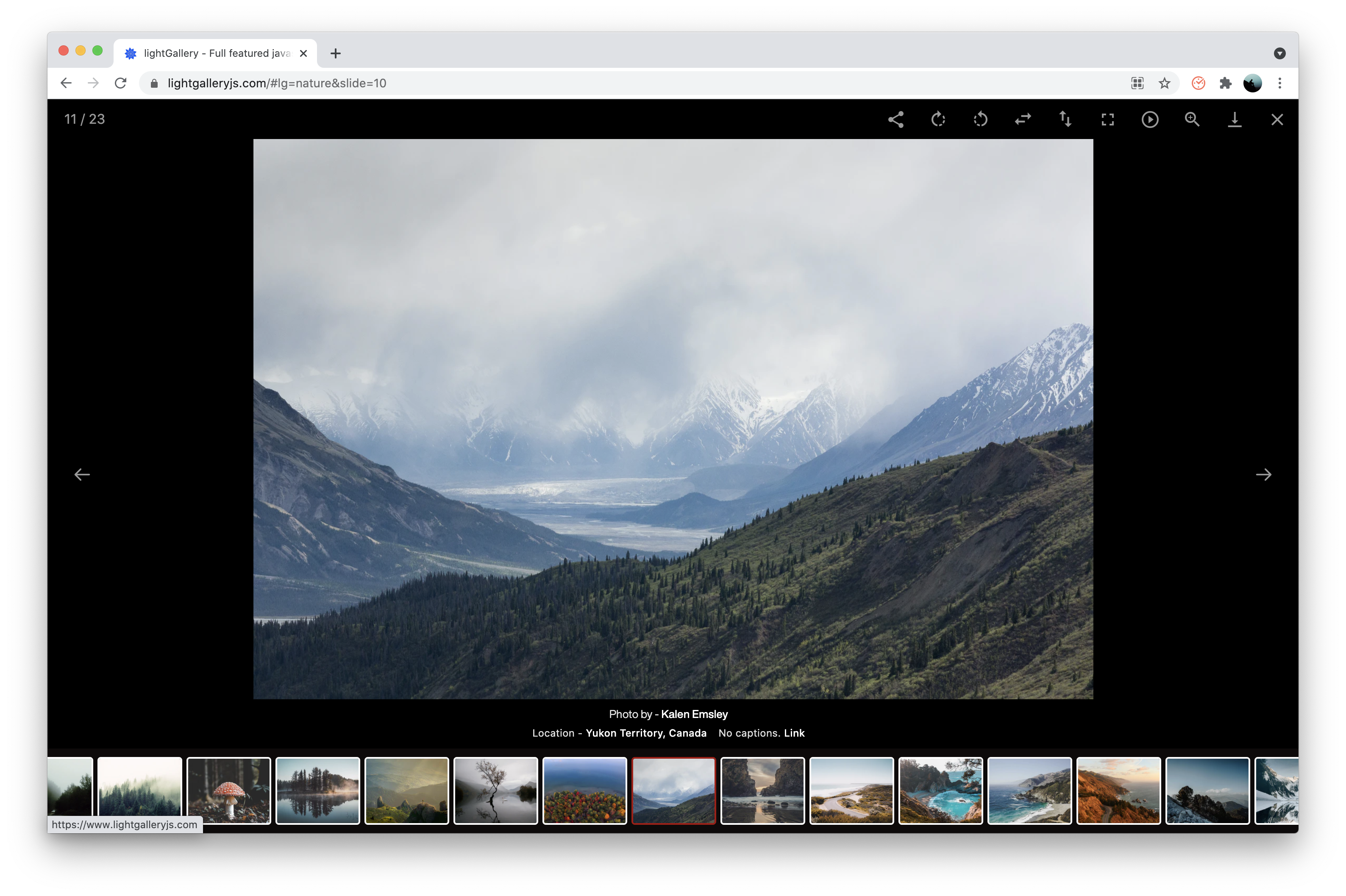
- Plain JavaScript or TypeScript, plus native React, Vue 3 and Angular packages. Same features and settings in every stack.
- No dependencies. Use it with a bundler or drop in a script tag.
- Lightweight. Plugins are separate files, so you only load what you use.
- 15 plugins, and you can write your own.
- Easy to customize with CSS (or SCSS) and settings. Multiple galleries on one page.
- Fully responsive, with the right image size for every screen.
- Justified layout: thumbnails in tidy rows of equal height, no extra library needed.
- Large galleries with thousands of images stay fast.
- Dynamic mode builds a gallery from a list of items, and you can add, edit or remove slides while it is open.
- Inline gallery and carousel modes.
- Smart preloading of the next slides.
- Built for touch, with mouse drag on desktop. Swipes glide and settle smoothly, like a native app.
- Swipe, drag or pinch to close.
- Zoom in and out, pinch to zoom, double-click or double-tap for actual size. Slides open from the thumbnail and close back to it.
- Animated thumbnails you can scrub through.
- 20+ smooth CSS3 transitions, or bring your own.
- Keyboard navigation and full screen support.
- Fits small screens: extra toolbar buttons tuck into a "More" menu.
- Accessible: works with screen readers and keyboards, and respects reduced motion.
- Localization and RTL: translate every label, and the gallery mirrors for right-to-left pages.
- YouTube, Vimeo, Wistia and HTML5 video, with lightweight previews that load the player only when you press play.
- Mixed content: photos, videos, maps, iframes and PDFs in one gallery.
- HTML captions for every slide.
- Rotate and flip images.
- Share through the phone's share sheet, or social links on desktop.
- Deep links: every slide gets its own URL, and the browser back button works.
- Autoplay slideshow with a progress bar, pager dots, comments, and a medium-zoom plugin for zooming images in place.
- SVG icons you can replace with your own.
- Getting started
- Settings, events and methods
- React, Vue, Angular and the headless core
- Accessibility
- Migrating from v2
- Troubleshooting
- Demos
Every docs page has a markdown twin at the same URL plus index.md, and llms.txt indexes them all.
- llms.txt lists every docs page in markdown, one request each.
- The getting-started guide has a prompt to paste into an agent. It picks the right package for the stack, imports the CSS, adds the zoom and thumbnail plugins and sets
lgSizeon every item. - This repository ships an agent skill at
skills/lightgallery/SKILL.mdthat teaches the same workflow for all four stacks.
lightGallery is available on NPM, Yarn, CDNs, and GitHub. You can use any of the following methods to download lightGallery.
-
NPM - NPM is a package manager for the JavaScript programming language. You can install
lightgalleryusing the following commandnpm install lightgallery
-
YARN - Yarn is another popular package manager for the JavaScript programming language. If you prefer you can use Yarn instead of NPM
yarn add lightgallery
-
GitHub - You can also download a release directly from GitHub
-
CDN - If you prefer to use a CDN, you can load files via jsdelivr, cdnjs or unpkg
First of all, include lightgallery.css in the <head> of the document. If you want include any lightGallery plugin such as thumbnails or zoom, you need to include respective css files as well.
Alternatively you can include lightgallery-bundle.css which contains lightGallery and all plugin styles instead of separate stylesheets.
If you like you can also import scss files instead of css files from the scss folder.
<head>
    <link type="text/css" rel="stylesheet" href="css/lightgallery.css" />

    <!-- lightgallery plugins -->
    <link type="text/css" rel="stylesheet" href="css/lg-zoom.css" />
    <link type="text/css" rel="stylesheet" href="css/lg-thumbnail.css" />


    <!-- OR -->

    <link type="text/css" rel="stylesheet" href="css/lightgallery-bundle.css" />
</head>
Then include lightgallery.umd.js into your document. If you want to include any lightgallery plugin you can include it after lightgallery.umd.js.
<body>
    ....

    <script src="lightgallery.umd.js"></script>
    <!-- Or use the minified version -->
    <script src="lightgallery.min.js"></script>

    <!-- lightgallery plugins -->
    <script src="plugins/thumbnail/lg-thumbnail.umd.js"></script>
    <script src="plugins/zoom/lg-zoom.umd.js"></script>
</body>
lightGallery supports AMD, CommonJS and ES6 modules too.
import lightGallery from 'lightgallery';

// Plugins
import lgThumbnail from 'lightgallery/plugins/thumbnail'
import lgZoom from 'lightgallery/plugins/zoom'
lightgallery does not force you to use any kind of markup. you can use whatever markup you want. Here can find detailed examples of different kinds of markups.
Give each anchor the natural size of its full image via data-lg-size="${width}-${height}". It drives the zoom-from-origin animation: the slide opens from the clicked thumbnail and closes back to it. Without the attribute the slide fades in instead.
<div id="lightgallery">
    <a href="img/img1.jpg" data-lg-size="1600-2400">
        <img alt=".." src="img/thumb1.jpg" />
    </a>
    <a href="img/img2.jpg" data-lg-size="1024-800">
        <img alt=".." src="img/thumb2.jpg" />
    </a>
    ...
</div>
Finally, you need to initiate the gallery by adding the following code.
<script type="text/javascript">
    lightGallery(document.getElementById('lightgallery'), {
        plugins: [lgZoom, lgThumbnail],
        licenseKey: 'your_license_key',
        speed: 500,
        // ... other settings
    });
</script>
Pass your key with the licenseKey setting.
- Commercial licenses come with a key by email once you purchase. lightGallery 3 keys start with
LIG. - Upgrading from v1 or v2? Your old key needs an upgrade for v3. The gallery keeps working in the meantime; see the license page for upgrade pricing.
- Open-source projects can request a free key at contact@lightgalleryjs.com.
- While you evaluate, use
0000-0000-000-0000. It unlocks every feature and plugin and only prints a reminder in the console.
As shown above, you need to pass the plugins via settings if you want to use any lightGallery plugins.
If you are including lightGallery files via script tag, please use the same plugins names as follows.
lgZoom, lgAutoplay, lgComment, lgFullscreen, lgHash, lgJustified, lgPager, lgRelativeCaption, lgRotate, lgShare, lgThumbnail, lgVideo, lgVimeoThumbnail, lgMediumZoom, lgOriginCrop
lightGallery works in all modern browsers: Chrome, Edge, Firefox and Safari on desktop, Safari on iOS and Chrome on Android, with no build step needed. Internet Explorer is not supported; lightGallery v2 remains available for it.
- Use it with a bundler, as a native ES module, or from a plain script tag.
- Newer browser features, such as the phone's share sheet, are used where available and fall back gracefully elsewhere.
If something misbehaves in a browser you care about, please open an issue with the browser and version.
Is lightGallery free? Yes. Every package and every plugin is free and open source under the GPLv3, for personal and commercial projects alike, as long as your project is distributed under GPLv3-compatible terms.
If you want to keep your own source proprietary, choose the commercial license. It covers the same code with every feature and plugin included, nothing is gated, and it is a one-time payment. See LICENSE-COMMERCIAL.md.
If the gallery misbehaves, the troubleshooting guide covers the symptoms behind most bug reports, with the fix for each package.
If you have any questions, suggestions, feedback, please reach out to contact@lightgalleryjs.com or DM me on X